


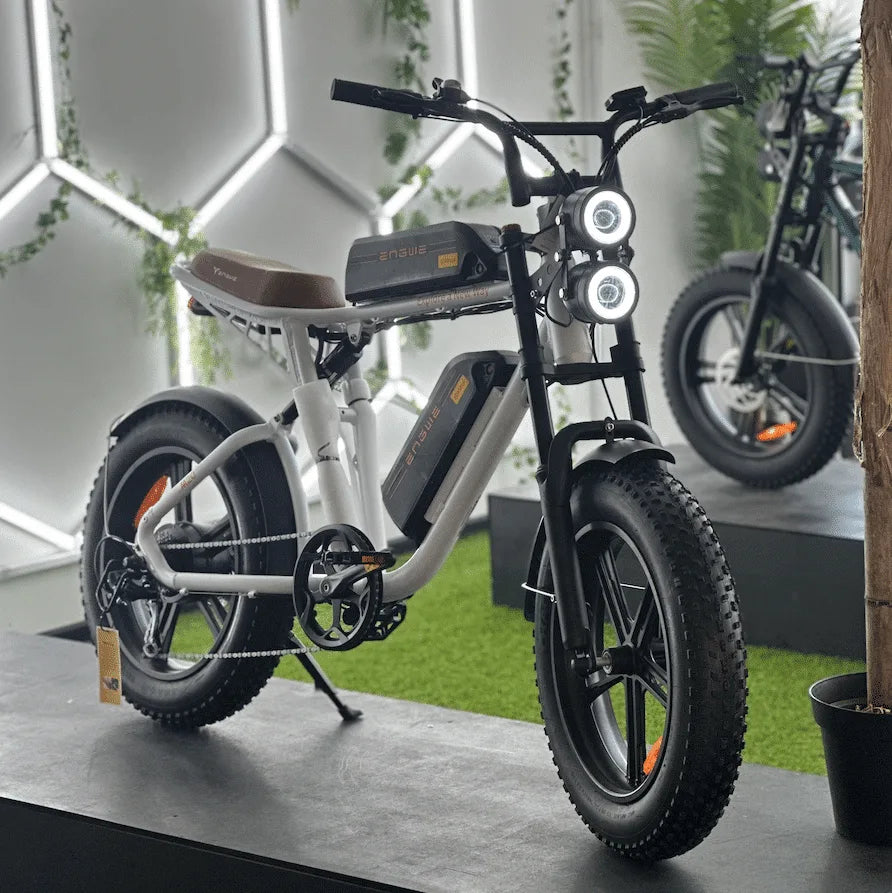
Fatbike Rules 2026: Helmet Requirement, Age, and Legislation Overview
Many new plans regarding fatbikes have been announced for 2025 and 2026. Helmet requirements, age limits, bans on modifications, stricter enforcement. In this article, you’ll read what currently applies, what will change, and what is still in the pipeline. Everything is based on official sources: the Dutch government, politie.nl, and recent announcements from the Ministry of Infrastructure and Water Management. Looking for a fatbike that meets all requirements? Check out the collection of legal fatbikes with 250W motors and pedal assistance up to 25 km/h.
Is there a helmet requirement for fatbikes in 2026?
No, in 2026 there is no general helmet requirement for fatbikes. This is the biggest misconception at the moment. The cabinet does have a bill in preparation, but it still needs to pass both the House of Representatives and the Senate. Minister Tieman (Infrastructure and Water Management) aims to submit the proposal to the House in fall 2026. If both chambers approve, the helmet requirement would only take effect in 2027.
What exactly does the plan include? It concerns an age-based helmet requirement for young people under 18. And not just for fatbikes, but for all electric bikes and light electric vehicles like e-scooters. Independent research showed three times that it is legally and practically impossible to distinguish fatbikes from other e-bikes. Manufacturers quickly adjust their models, and the police cannot technically differentiate them on the road. Therefore, the new rules will apply to all e-bikes.
Until then, wearing a helmet is a recommendation, not a legal obligation. For your own safety, it is wise to wear one, especially for children. VeiligheidNL reported that in 2024 more than 300 young people ended up in emergency care after a fatbike accident, more than half of whom were between 12 and 18 years old. The number of head injuries among young e-bike riders has increased five- to sixfold since 2020.
Is there an age limit for fatbikes?
For legal fatbikes that meet the requirements of a regular electric bike, there is no legal minimum age. Children may in principle also ride a fatbike as long as they can operate the bike safely. Many parents choose a smaller version of the fatbike for their child. For this, we have a separate collection of children’s fatbikes with models suitable from about 6 years old.
For modified or illegal fatbikes (classified as mopeds), there is a minimum age of 16 and you must have an AM driving license. The cabinet is also investigating a legal minimum age for all e-bike riders, but that requires a legislative change that will take at least two years and needs a majority in parliament. So in 2026, there is still no fixed minimum age.
The House of Representatives originally wanted to introduce a separate minimum age for fatbikes, but that proposal failed for the same reason: distinguishing between fatbikes and e-bikes is not feasible.
What is a legal fatbike in 2026?
In the Netherlands, a fatbike is legally equivalent to an electric bike, provided it meets these technical requirements:
- Maximum 250 watt motor power
- Pedal assistance up to a maximum of 25 km/h
- Motor only works when you pedal yourself
- No throttle that provides assistance above 6 km/h
- Properly functioning lights (front and rear)
- Properly functioning brakes
If the fatbike meets these criteria, the same rules apply as for a regular bike: no license required, no registration plate, no mandatory insurance. Insurance is allowed and recommended but not legally required. Want to read more about how to arrange that? Check the article fatbike insurance.
Popular brands that meet these requirements by default include OUXI, V20, Engwe, and Jobobike. When in doubt, ask for the manufacturer’s declaration of conformity. For example, all models in the Ouxi fatbikes collection fully comply with Dutch law.
When is a fatbike illegal?
As soon as a fatbike violates one of the above requirements, it is legally no longer a bike but a moped or light moped. This happens when:
- There is a throttle that allows speeds over 6 km/h without pedaling
- A modified or removed speed limiter (assistance above 25 km/h)
- A motor stronger than 250 watts
- Even the presence of a tuning kit or dealer code is enough for a fine since late 2025, even if you are not caught speeding
Different rules apply for mopeds: AM license, registration plate, liability insurance, helmet requirement, and minimum age 16. Most modified fatbikes do not meet any of these requirements, so riding them on public roads is not allowed.
What fines apply in 2026?
The official fine from the Dutch government for a modified fatbike or a fatbike with a throttle is €320. For repeat offenses (a second violation within two years), the police may confiscate the fatbike and possibly have it destroyed. If you are under 16, the fine is halved to €160, but the notice will be sent to your parents or guardian.
Since late 2025, the police have more room to enforce these rules. Five judges ruled that the mere presence of a tuning function is enough for a fine, even if you are not riding faster than 25 km/h at the time of the check. Enforcement has thus become easier, and targeted controls on bike paths are increasing. In February 2026, 51 fatbikes were checked in Oosterhout in one day, resulting in multiple fines.
Besides the fine itself, there are additional consequences. Your insurance does not cover damage on an illegal fatbike. In case of an accident, you are personally liable for all costs, including medical damages to others. This can amount to tens of thousands of euros. What about insurance for legal fatbikes? You can read about it in our overview fatbike insurance: calculate your premium.
What changes in 2026 and 2027?
2026 remains a transition year. The major legislative change (helmet requirement for youth under 18) is expected to be submitted in fall 2026. Implementation: earliest 2027. Additionally, the ministry is working on:
- A behavioral approach with campaigns targeting young e-bike riders
- A quality mark for electric bikes so consumers can clearly see which models are safe
- More intensive enforcement on modified fatbikes, in cooperation with the police and Public Prosecution Service
For municipalities with local fatbike nuisance (think Enschede and Amsterdam), it is being investigated whether they may set their own rules via the General Local Regulation (APV). Some municipalities are already experimenting with fatbike zones where riding is prohibited.
What does this mean for you?
Do you want to buy a fatbike now or already ride one? The main takeaways for 2026:
- You don’t need a helmet, but wearing one is smart, especially for children under 18.
- There is no minimum age for legal fatbikes, but consider what your child can handle.
- Buy a fatbike that complies with the 250W rule and 25 km/h limit. If in doubt, check the specs with the seller.
- Modifying your fatbike is not advisable: €320 fine, bike confiscation on repeat offenses, no insurance coverage in case of an accident.
- The helmet requirement will likely come in 2027 for all e-bikes and fatbikes for youth under 18.
For more background on the debate about fatbike bans, read the article about whether fatbikes will be banned. Still unsure if a fatbike is right for you? The knowledge base has answers to the most frequently asked questions.

Leave a comment
This site is protected by hCaptcha and the hCaptcha Privacy Policy and Terms of Service apply.